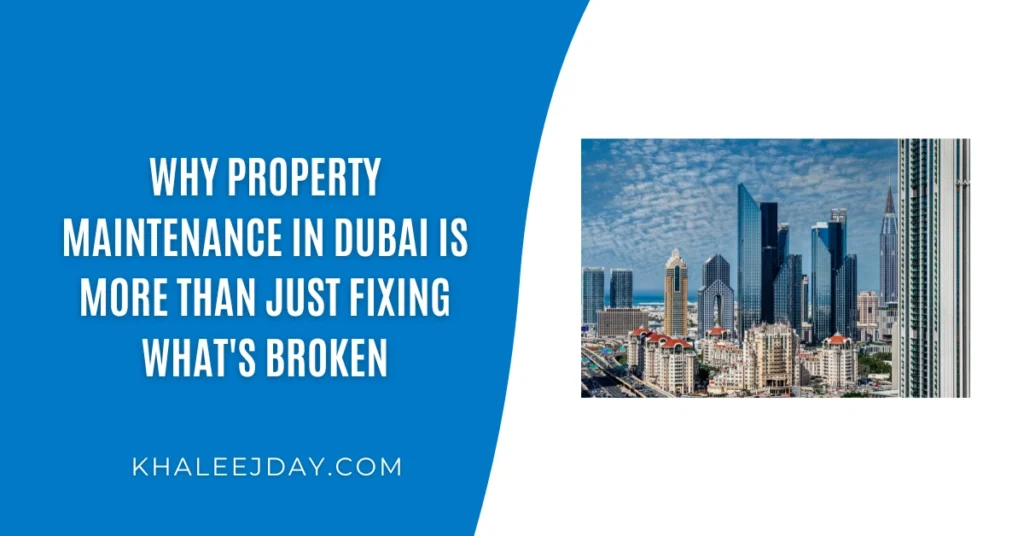
Why Property Maintenance in Dubai Is More Than Just Fixing What’s Broken
Running a property in Dubai is no small thing. The heat alone puts systems under constant stress, and with how fast the city moves — new developments, rising tenant expectations, buyers who know what they’re looking for — you really can’t afford to let things slip. Even a few months of neglected maintenance can show up in ways that hurt your bottom line.
The thing is, most property owners only think about maintenance when something goes wrong. A pipe bursts, the AC stops working, a tenant complains — then the phone calls start. It works, until it doesn’t. What that cycle misses entirely is how you maintain a property directly affects its value.
The Dubai Factor
Most cities have one or two environmental factors that make maintenance tricky. Dubai has several running at the same time. The heat, the humidity, the coastal air, the sand — each one on its own would be enough to accelerate wear on a building’s systems. Together, they create conditions where things deteriorate faster, faults develop sooner, and ignoring upkeep has a way of catching up with you quickly. It’s one of the main reasons property maintenance in Dubai looks quite different from what you’d find in most other markets.
This isn’t unique to older buildings. Even newer developments benefit from proactive upkeep — catching minor faults before they escalate into costly repairs or, worse, safety hazards. Dubai’s construction boom over the past two decades has left a large portion of its residential and commercial stock aging into a maintenance-critical phase, where systems that were once new are now in need of serious attention.
Preventive vs. Reactive: The Real Cost Difference
Here’s what reactive maintenance actually costs you — not just in repair bills, but in timing. An AC unit that last saw a technician two summers ago isn’t running well and won’t last much longer. When it finally gives out, chances are it’ll be during a heatwave, when every maintenance company in Dubai is already stretched and getting someone out fast comes at a premium. Preventive servicing isn’t a luxury spend. It’s what keeps you out of that situation in the first place.
Plumbing tells a similar story. A leak that goes unnoticed for a few months doesn’t stay a small problem — it works its way into walls, floors, and structural elements until the fix is anything but simple. Rooftop waterproofing is the same: neglect it long enough, and you’re dealing with water ingress that damages interiors and drives up repair costs fast. And joinery — doors, frames, fixtures — wears out sooner than you’d think when it’s constantly exposed to Dubai’s humidity swings.
Landlords and property managers don’t need much convincing once they’ve been through it once. A unit that’s behind on maintenance is harder to fill, harder to justify at a higher price, and more likely to have tenants calling with complaints. When you stack that against the relatively predictable cost of keeping things in good order, the decision isn’t really a close one.
Electrical Systems: Not an Area to Cut Corners
Among all building systems, electrical is the one where professional oversight matters most. Research into thousands of fire incidents in Dubai found that electrical failures were the leading cause of accidental fire ignition — ahead of all other factors. Short circuits, overloaded circuits, and poorly maintained distribution boards pose a risk to both residential and commercial properties.
This is particularly relevant in older buildings where wiring may not have been designed to handle the electrical loads of modern living — think multiple high-draw AC units, home automation systems, and constantly charging devices all running simultaneously. Engaging qualified electrical services in Dubai isn’t optional for a responsibly managed property; it’s a basic safeguard.
The best providers in this space use tools like thermal imaging cameras to detect heat buildup in wiring and panels long before anything trips or sparks. Circuit load checks, distribution board inspections — these aren’t extras, they’re the basics of doing electrical work properly. And the reason they exist is straightforward: electricity doesn’t give you many second chances. By the time a fault becomes apparent, it’s often already dangerous.
Annual Maintenance Contracts: A Smarter Model
More property owners and facility managers in Dubai are moving toward Annual Maintenance Contracts — and it’s not hard to see why. Instead of hunting for an available technician every time something breaks, you have a team that already knows your property, shows up on a schedule, and moves you to the front of the queue when something urgent comes up. It’s a different way of thinking about maintenance, and once you’ve experienced it, the old way feels unnecessarily stressful.
The practical value is significant. Scheduled visits mean issues are identified and resolved before they become emergencies. Priority callout terms mean that when something does go wrong unexpectedly, you’re not waiting in a queue behind non-contract customers. And because the provider is familiar with your specific systems and setup, diagnosis and resolution tend to be faster.
For landlords managing multiple units, or for homeowners who simply don’t want to manage maintenance logistics, this model offers genuine peace of mind. It also tends to be more cost-effective than ad-hoc callouts over the course of a year — particularly when you factor in the avoided cost of breakdowns that preventive checks would have caught early.
What Good Maintenance Actually Looks Like
Not all maintenance is created equal, and not all providers deliver the same level of service. A few things to look for when evaluating a company for property maintenance in Dubai.
Before anything else, check that whoever you’re hiring is licensed and insured for the work you’re asking them to do. This is especially true for electrical, plumbing, and structural jobs — the kind where an unqualified technician or an uncovered incident can create problems that go well beyond the original repair. A reputable company will have no issue confirming this. One who hesitates probably should.
Second, response time and availability. Dubai’s climate means that certain failures — an AC breakdown in July, a water leak in a high-occupancy building — need to be addressed quickly. Providers who offer 24/7 emergency support and commit to response time windows give property owners meaningful protection.
Third, integration. Managing multiple contractors for different trades is time-consuming and creates gaps — situations where no single provider owns the problem. A company that can handle AC, plumbing, electrical, carpentry, and general upkeep under one roof simplifies the entire process and creates clearer accountability.
And don’t underestimate reputation. Dubai is a word-of-mouth market — people talk, and companies that consistently do good work tend to be known for it. Look at reviews across platforms, ask about the kinds of projects they’ve handled, and pay attention to whether they have experience across both residential and commercial properties. A long track record in this market means they’ve seen most of what can go wrong — and know how to handle it.
A Property Is Only as Strong as Its Upkeep
Property ownership in Dubai is a serious investment, and protecting that investment means treating maintenance as an ongoing commitment rather than an afterthought. The properties that hold their value, retain good tenants, and avoid expensive emergency repairs are almost always the ones that are cared for consistently — not just when something breaks.
Reactive maintenance fixes problems. Proactive property maintenance prevents them.