How to choose among Cartier watches by shape, movement and size
Shape is the first decision with Cartier watches, and it’s easy to overlook. A rectangular Tank, a square Santos and a soft oval Baignoire don’t behave the same way on a wrist. Each sits differently under a cuff and reads differently at a glance.
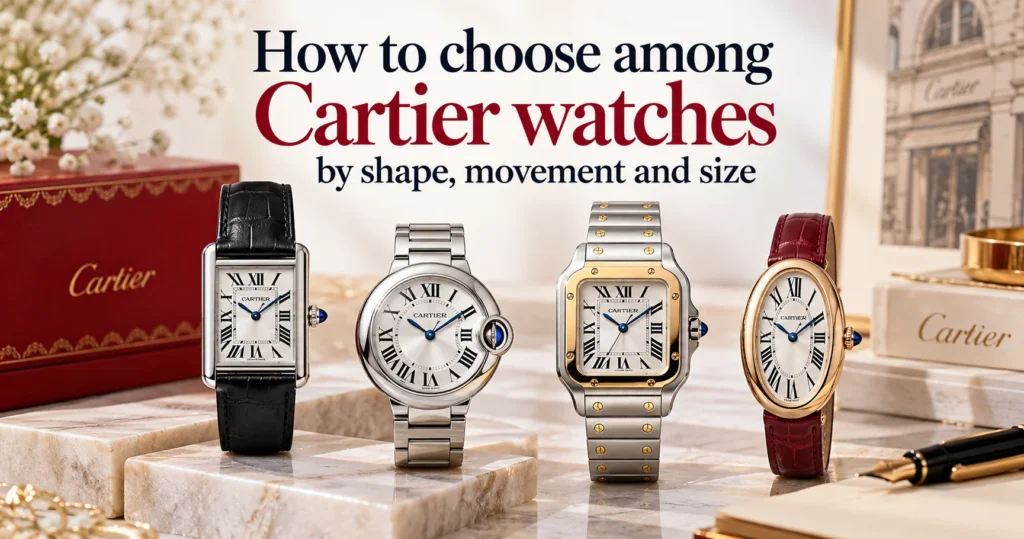
Before narrowing anything down, it helps to see the range side by side. An online catalog such as https://dream-watch.ae/en/swiss-watches/cartier lays the main collections out together, which makes the differences easy to compare. Once you know which outline you like, everything else gets easier.
Why Cartier is chosen by shape first
Cartier built its reputation on case design rather than on one signature movement. The range spans Tank, Santos de Cartier, Panthère de Cartier, Pasha, Ronde, Ballon, Baignoire, Tortue and Roadster, and many of them are recognizable from across a room.
Round, rectangular, square and oval cases cover most of the range, while tonneau and cushion shapes are rarer. Choosing a Cartier watch therefore starts with a simple question about how much of your wrist the case should cover and what outline it should draw.
Tank and Santos for everyday wear
The Tank is a rectangle with vertical emphasis, which visually lengthens the wrist and slips easily under a shirt cuff. The Tank MC, for example, measures about 34.5 mm by 44 mm, so it’s taller than it is wide. That proportion suits slimmer wrists well.
The Santos is squarer and more assertive. Its exposed bezel screws and a bracelet that flows straight out of the case give it a utilitarian edge, and sizes run from about 39.8 mm to 47.5 mm in current listings. Anyone choosing a single Cartier wrist watch for daily wear should try both, because the Tank reads as dressy and the larger Santos as sporty.
Panthère, Baignoire and Ballon Bleu for softer lines
Panthère takes the square case and softens it with rounded corners and a supple link bracelet. It comes in Mini, Small and Medium sizes, which makes it a natural starting point for a smaller wrist.
Baignoire, French for bathtub, is an elongated oval that hugs the wrist and looks almost like jewelry. Ballon Bleu is round, with a gently curved case and a crown tucked into a protective guard. If you want a Cartier timepiece that feels fluid instead of architectural, these three are where to look first.
Quartz or automatic movement
Listings split almost evenly between automatic and quartz, and manual winding is a rarity. That balance means you can choose by lifestyle instead of by availability.
An automatic movement winds itself with the motion of your arm. It has real charm, but it needs regular wear and periodic servicing. Quartz runs on a battery, keeps steady time and tolerates a few days in a drawer. For anyone who rotates between several pieces, quartz is the lower-effort option, and plenty of Cartier watches come with it.
Sizes and materials worth comparing
Size labels run from Mini and Small through Medium and Large to XL. The number on the label isn’t the whole story, though, because on elongated cases the length matters as much as the width.
A few points deserve a closer look before you decide:
- Case dimensions in both width and length, since a 34.5 mm by 44 mm case wears differently from a round one of similar width.
- Steel for easy everyday wear, or rose and yellow gold when you want warmth and a dressier look.
- Alligator leather straps look elegant but dislike water, so a metal bracelet is the safer choice for daily use.
- Diamond and skeleton versions, which form a smaller group and suit formal occasions.
Whichever of the Cartier watches you settle on, try the shape on your own wrist before worrying about the details. A few minutes with a mirror and a shirt cuff usually settles what a spec sheet can’t.