Essential Tips Every Traveler Should Know Before Renting a Car in Dubai
Your flight just landed at Dubai International Airport. You’ve cleared customs, grabbed your luggage, and now you’re thinking about your next move. Public transport? Taxis? Neither gives you the freedom to explore this incredible city on your own schedule. That’s why thousands of visitors choose to rent a car in Dubai every year.
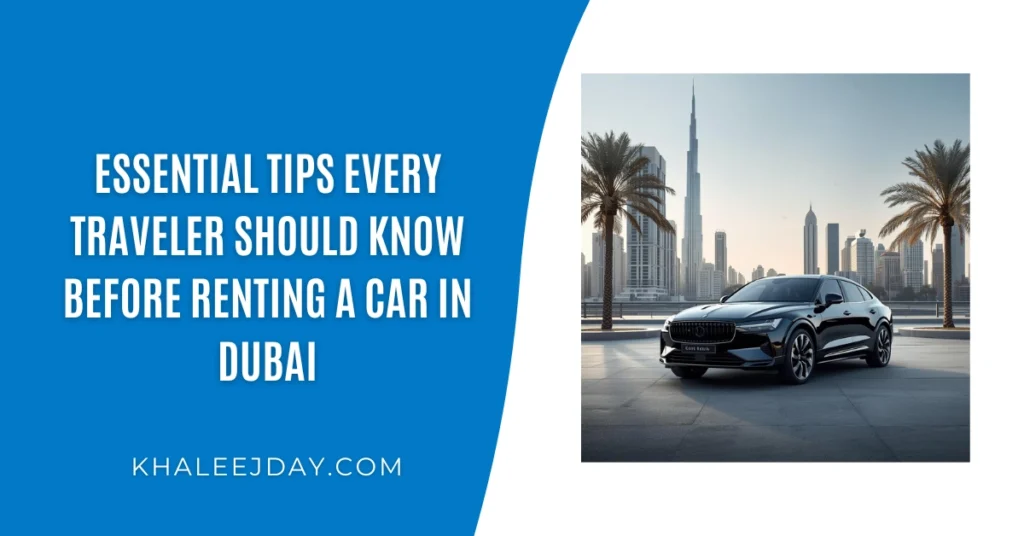
But driving back home is not like driving in Dubai. The rules are stricter, the fines are hefty, and one wrong move can turn your dream vacation into an expensive headache. This guide walks you through everything you need to know before getting behind the wheel in Dubai, from the documents you must carry to the driving habits that could save you thousands of dirhams in fines.
1. Required Documents for Renting a Car in Dubai
You cannot just show up and drive in Dubai. The requirements depend on where you’re from, and getting this wrong means you won’t be driving anywhere.
1.1 Home Country Driving License
This is non-negotiable. Your license must be valid, full (not provisional or learner’s), and ideally in English. If your license is not in English, you’ll need a certified translation. The license should match the name on your passport exactly. Any mismatch raises red flags with rental companies. Newer drivers might face higher deposits or limited vehicle options.
1.2 International Driving Permit (IDP)
Whether you need an IDP depends entirely on your nationality. Drivers from certain countries can drive with just their home license, while others must have an IDP.
Countries that don’t need an IDP include: the USA, the UK, Canada, Australia, New Zealand, most European Union nations, Japan, South Korea, Singapore, and several Gulf countries. If you’re from India, Pakistan, the Philippines, or most other countries not on this list, you’ll need an IDP in addition to your home license.
Here’s what catches people: an IDP isn’t a standalone document. It’s a translation of your home license and must be presented together with your original license. You get it from your home country before traveling. You cannot obtain one in Dubai as a tourist.
1.3 Passport and Visa
Your passport is your primary identification. The rental company will make copies of your passport photo page and your UAE entry stamp or visa page. Your tourist visa must be valid for the entire rental period.
Keep these documents with you every time you drive. Police stops are rare but do happen, and you must produce these documents on request. Store them in the glove compartment, not in your hotel safe.
1.4 Credit Card
Cash won’t work for car rentals in Dubai. You need a credit card, not a debit card, in the primary driver’s name. This is for the security deposit, which ranges from AED 1,500 to AED 5,000 depending on the car type.
The deposit is blocked on your card and released after you return the car without damage or fines. This process can take 3-4 weeks because rental companies wait for any traffic fines to appear in the system before releasing your deposit.
2. Age Requirements for Car Rental
The legal driving age in Dubai is 18, but the rental age is different. Most companies require you to be at least 21 years old. Some set the minimum at 23, and luxury or sports car rentals often require you to be 25 or older.
If you’re under 25, expect to pay a young driver surcharge, typically AED 35-100 per day. This isn’t negotiable, so factor it into your budget.
3. Insurance: What You Need to Know
Every rental car in Dubai comes with basic third-party liability insurance by law. This covers damage you cause to other people or property, but not to your rental car.
Most rental agreements include a Collision Damage Waiver (CDW), but there’s usually an excess amount, the maximum you’d pay out of pocket if there’s damage. This excess typically ranges from AED 1,500 to AED 3,500 for standard cars, and much higher for luxury vehicles.
Read the insurance section of your rental agreement carefully. Understand what’s covered and what isn’t. Tire damage, undercarriage damage, and roof damage are often excluded from standard coverage. If you’re planning any desert driving, verify this is covered. Many policies explicitly exclude off-road use.
Your travel insurance or credit card might offer rental car coverage. Check before you travel and understand the terms. Some credit cards provide excellent coverage that can save you AED 50-80 per day in insurance upgrades.
4. Dubai Driving Rules You Cannot Ignore
Dubai’s traffic laws are strict, and ignorance isn’t an excuse. Here’s what you absolutely must know.
4.1 Drive on the Right
Traffic flows on the right side of the road in Dubai. If you’re from the UK, Japan, Australia, or anywhere else that drives on the left, this takes conscious adjustment. The steering wheel is on the left side of the car, which helps, but your instincts at roundabouts and turns might betray you initially.
4.2 Speed Limits Are Strictly Enforced
Speed cameras are everywhere, and I mean everywhere. They’re on highways, city roads, at intersections, and in residential areas. Many are hidden or positioned to catch you by surprise.
Highways typically allow 100-120 km/h, major city roads allow 60-80 km/h, and residential areas allow 40 km/h or less. Always watch for posted signs because limits can change suddenly.
Here’s something crucial: Dubai has a 20 km/h buffer zone above the speed limit on most roads. This means if the limit is 100 km/h, you won’t get fined until you hit 121 km/h. However, this buffer doesn’t exist everywhere. In Abu Dhabi, there’s zero tolerance; even 1 km/h over the speed limit gets you fined. School zones and certain innovative zones also have a zero-tolerance policy.
Don’t rely on this buffer as your safety net. Speed limits are there for a reason, and cameras are calibrated precisely.
4.3 Seat Belts for Everyone
Every passenger must wear a seat belt, front and back. Children under four must be in proper child safety seats. Kids under 10 cannot sit in the front seat, period. The fine for not wearing a seat belt is AED 400, and you get four black points (more on that later).
4.4 Zero Tolerance for Alcohol
This cannot be stressed enough: Dubai has absolute zero tolerance for drinking and driving. Even trace amounts of alcohol in your blood can lead to immediate arrest, jail time, hefty fines, and deportation. This isn’t a “don’t drink too much” situation. It’s “don’t drink at all if you’re driving.”
If you’re at a restaurant and have even one beer, take a taxi home. It’s not worth the risk.
4.5 Phone Use While Driving
Using your phone while driving, even at a red light, is illegal and carries a fine of AED 800 plus 4 black points. This includes texting, calling without a hands-free device, or even holding your phone.
Use a phone mount and Bluetooth for navigation and calls. Keep your phone out of reach if you can’t resist checking it.
4.6 Roundabouts
Dubai has plenty of roundabouts, and the rule is simple: traffic already in the roundabout has the right of way. Yield when entering, signal when exiting, and stay in your lane. Multi-lane roundabouts can be confusing. The inner lane is for going straight or turning right, while the outer lane is for turning right only.
5. Dubai Black Points System
Dubai uses a black points system to track dangerous driving. When you commit certain traffic violations, you get fines plus black points added to your driving record.
Accumulate 24 black points within one year, and your license gets suspended. For tourists, this is handled through the rental company, but the consequences are real: you could lose your ability to rent cars in the UAE.
Here’s how black points stack up:
- Exceeding speed limit by 60+ km/h: 12 black points
- Running a red light: 12 black points
- Driving recklessly: 23 black points
- Not wearing a seat belt: 4 black points
- Using a phone while driving: 4 black points
- Illegal overtaking: 6 black points
Most tourists won’t get 24 points during a short visit, but it’s worth understanding the system. Serious violations, such as reckless driving, can result in immediate license suspension regardless of total points.
6. Parking Rules & Payment in Dubai
Finding parking in popular areas like Dubai Mall or Jumeirah Beach can be challenging, but the rules are straightforward once you understand them.
6.1 Paid Parking Zones
Many areas have paid parking, marked by signs showing operating hours (typically 8 a.m. to 10 p.m. on weekdays, 8 a.m. to midnight on weekends in busy areas). You’ll see parking meters or payment kiosks.
The easiest way to pay is through the RTA Dubai Drive app. Download it, register your car’s license plate number, and pay directly from your phone. You’ll get notifications when your parking is about to expire, and you can extend it remotely.
Alternatively, you can pay via SMS by texting the zone number and your license plate to 7275. Each area has a zone number displayed on signs.
Parking rates vary by area but typically range from AED 2-4 per hour in regular zones and up to AED 10 per hour in premium areas.
6.2 Free Parking
Most malls offer free parking, though premium malls like Dubai Mall may charge during peak hours. Hotels often provide parking for guests and diners. Residential areas usually have free parking except in marked paid zones.
6.3 Parking Fines
Parking violations are one of the easiest ways to rack up fines:
- Parking in disabled spots without a permit: AED 1,000
- Parking on pavements: AED 400
- Parking in no-parking zones: AED 500
- Blocking traffic: AED 1,000
- Overstaying paid parking without payment: AED 200-400
Your rental car’s license plate is tracked, and fines are automatically charged to the rental company, which then charges your credit card plus an administration fee.
7. The Salik Toll System
Dubai uses an electronic toll system called Salik (Arabic for “clear”). There are currently 10 toll gates across Dubai, primarily on Sheikh Zayed Road and major highways.
You don’t stop or slow down at toll gates. They’re completely automated. A sensor reads your car’s license plate or the Salik tag in the windshield and automatically deducts AED 6 from the rental company’s account.
The rental company then charges you for these tolls when you return the car, usually adding an administration fee of AED 1-2 per crossing. A week in Dubai can easily result in AED 50-100 in toll charges if you’re driving between Dubai Marina, Downtown, and other areas daily.
You can avoid tolls by using alternate routes. Enable “avoid tolls” on Google Maps or Waze, and you’ll see toll-free options. Sometimes these routes are only a few minutes longer and save you multiple toll charges.
8. Common Traffic Fines in Dubai:
Dubai’s traffic fines are no joke. They’re designed to hurt enough that you won’t repeat the offense.
Common fines you need to know:
- Speeding 20-30 km/h over limit: AED 300
- Speeding 30-40 km/h over the limit: AED 700
- Speeding 40-60 km/h over limit: AED 1,000
- Speeding 60+ km/h over limit: AED 2,000-3,000
- Running a red light: AED 1,000
- Illegal parking: AED 200-1,000
- Not wearing a seat belt: AED 400
- Using phone while driving: AED 800
- Changing lanes without indicating: AED 400
The rental company charges these fines to your credit card, plus an administration fee of AED 50-100 per fine. Fines take 3-4 weeks to appear in the system, which is why your deposit is held that long.
9. Lane Discipline and Highway Etiquette
Dubai highways are fast, and drivers can be aggressive. Understanding lane discipline keeps you safe and ticket-free.
The rightmost lane is the slow lane. Use it for cruising at or below the speed limit. The middle lanes are for everyday speed travel. The leftmost lane is the fast lane. Use it only for overtaking, then move back to the right.
Staying in the fast lane when you’re not overtaking is illegal and can result in a fine of AED 400. If someone behind you flashes their headlights, they’re asking you to move over. Don’t take it personally, signal and move to the right lane when safe.
Tailgating is common in Dubai but illegal (AED 400 fine plus four black points). Maintain a safe following distance. The three-second rule applies: pick a fixed point ahead, and when the car in front passes it, count three seconds before reaching that same point.
10. Dos and Don’ts for Dubai Driving
Do:
- Use GPS navigation religiously. Google Maps and Waze work excellently in Dubai
- Keep all documents (license, rental agreement, passport) in the car at all times
- Drive defensively and anticipate aggressive drivers
- Use indicators for every lane change and turn
- Stay patient in traffic. Dubai gets congested during rush hours (7–9 a.m. and 5–8 p.m.)
- Take photos of the car’s condition before and after your rental period
- Refuel before returning the vehicle to avoid inflated refueling charges
Don’t:
- Speed, even by a little, cameras are everywhere
- Use your phone while driving, even at red lights
- Don’t drink any alcohol if you’re driving later that day
- Honk unnecessarily. It’s considered rude and can be fined
- Make rude gestures at other drivers. This is a serious offense in the UAE culture
- Parking illegally to save time, towing, and fines cost more than paid parking
- Assume right of way, even if you have it legally, drive defensively
- Drive in bus lanes or emergency lanes
11. What to Do If Police Stop You
Traffic police in Dubai are professional and courteous. If you’re pulled over:
- Pull over safely to the right side of the road
- Turn off your engine and stay in the car unless asked to step out
- Keep your hands visible on the steering wheel
- Be polite and respectful
- Have your documents ready: driving license, IDP (if applicable), passport, and rental agreement
- If you don’t speak Arabic, English is widely understood among the police
- Never attempt to bribe an officer. This is a serious crime.
If you receive a fine, the officer will explain the violation. The fine is recorded in the rental company’s system, not directly to you. Don’t argue or refuse the ticket. Handle it through proper channels if you believe it’s incorrect.
12. Choosing the Right Rental Company in Dubai
Your rental experience depends heavily on choosing a reputable company. Large international chains like Hertz, Budget, and Avis offer consistency but often at higher prices. Local companies can provide better value. Rentakar.ae, for instance, has built a strong reputation for transparent pricing and quality service among tourists.
Look for companies with:
- Transparent, upfront pricing with no hidden fees
- Comprehensive insurance is included in the quoted price
- Good reviews from recent customers (check Google, TripAdvisor)
- 24/7 customer support
- Proper licensing from Dubai’s Roads and Transport Authority
Read the rental agreement before signing. Understand the fuel policy, mileage limits, additional driver fees, and your responsibility for fines and tolls. Ask questions about anything unclear; it’s better to be overcautious than to get surprised later.
Conclusion
Driving in Dubai is not as intimidating as it might seem. The roads are excellent, signage is clear in English and Arabic, and most drivers are reasonably courteous despite the reputation for speed.
Your biggest challenges will be adjusting to the strictness of enforcement and the pace of highway traffic. Start with easier routes. Drive around your hotel area first to get comfortable. Avoid rush hours if possible during your first few days. Use GPS religiously, even for routes you think you know.