Dechecker AI Checker: Making AI-Written Text Feel Human Again
Most people don’t worry about whether a sentence was written by AI—until it starts to matter. A school assignment gets flagged, a blog post feels oddly flat, or a client says the copy sounds “generated.” That moment of hesitation is exactly where Dechecker enters the picture, not as a loud solution, but as a quiet corrective tool.
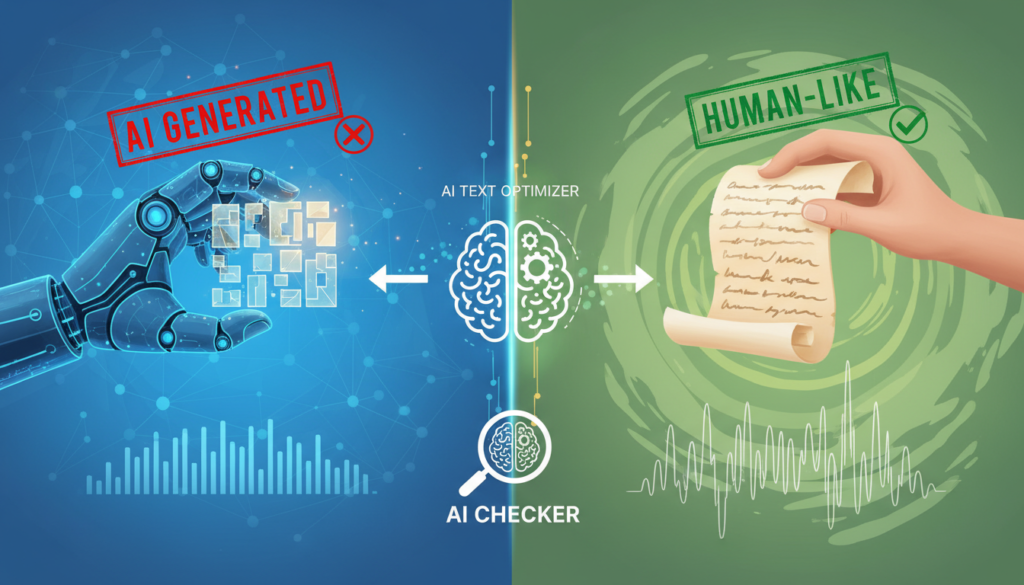
When AI Writing Stops Feeling Helpful
Using AI to write is no longer controversial. The problem appears later, usually when the text leaves your screen and meets a real audience.
The Subtle Signals Editors Notice
Editors rarely say “this was written by AI.” Instead, they pause. They reread. Something feels too even, too balanced, too safe. Sentences arrive with the same rhythm. Paragraphs close too cleanly. Over time, these patterns become recognizable, even if no one can point to a single broken rule.
This is where an AI Checker becomes practical rather than theoretical. Not as a detector for punishment, but as a mirror that shows how your text might be perceived by someone trained to read between the lines.
Detection Is About Risk, Not Blame
In academic and professional settings, the concern isn’t morality—it’s exposure. Students worry about automated review systems. Marketers worry about platform trust. Writers worry about credibility. Running text through an AI Checker gives you an early signal, the same way spellcheck once did, before grammar mistakes became unacceptable.
How Dechecker Approaches AI Detection Differently
Many detection tools promise certainty. Dechecker doesn’t. Instead, it leans into probability, context, and pattern recognition.
Reading the Shape of Language
Rather than hunting for specific phrases, Dechecker evaluates structure. Sentence length variation. Predictability of transitions. Overuse of neutral framing. These are not errors, but they accumulate. When enough of them appear together, the text starts to feel engineered.
Writers often notice this only after seeing a report. A paragraph they felt confident about suddenly looks too smooth. That awareness alone changes how they revise.
Working With the Writer’s Intent
A key difference is that Dechecker assumes you want the text to succeed. It doesn’t label content as “bad.” It highlights where language choices reduce human texture, inviting adjustment rather than replacement.
Rewriting Without Losing Your Voice
Detection is only half the story. The harder part is revision.
Why Simple Paraphrasing Fails
Many users try to “fix” AI-sounding text by swapping synonyms or shortening sentences. The result often looks different but feels the same. The rhythm stays flat. The tone stays distant.
Human writing rarely optimizes for balance. It hesitates. It leans too far, then corrects itself. Dechecker’s rewriting approach focuses on restoring those small imperfections that readers subconsciously trust.
Where AI Humanizer Fits In
In practice, this is where the AI Humanizer becomes useful. Instead of rewriting everything, it selectively reshapes phrasing, breaking predictable flows and reintroducing natural variation. Writers often keep most of the original text, adjusting only what interrupts the reading experience.
Academic Writing Under Real Pressure
Students are often the first to feel the impact of AI detection, not because they misuse tools, but because their work is scrutinized more closely.
Homework That Sounds “Too Good”
AI-assisted homework often fails for an unexpected reason: it lacks struggle. Teachers expect uneven confidence. A strong paragraph followed by a weaker one. A conclusion that tries but doesn’t fully land. Perfect balance can raise more questions than minor mistakes.
Dechecker helps students see where their work might feel overly polished and guides revisions that preserve effort without inviting suspicion.
Studying With Support, Not Shortcuts
As an AI homework helper, Dechecker doesn’t replace learning. It supports reflection. Students compare drafts, notice which changes feel more like their own thinking, and gradually internalize better writing habits. Over time, they rely less on correction and more on judgment.
Content Creation Beyond Detection Scores
Outside classrooms, the stakes shift but the problem remains familiar.
Marketing Copy That Feels Replaceable
In marketing, AI-generated copy often passes basic checks but fails engagement. It explains, but doesn’t persuade. It informs, but doesn’t commit. Readers scroll past because nothing pulls them in.
Running drafts through Dechecker helps writers identify where language plays it too safe. Small adjustments—an opinion stated more clearly, a transition made less formal—can change how long a reader stays.
SEO Without the Mechanical Feel
Search engines increasingly reward content that behaves like it was written by someone who cares. Not just keyword presence, but pacing, emphasis, and depth. By aligning AI-assisted drafts with human reading patterns, Dechecker indirectly supports long-term SEO performance without forcing formulaic optimization.
Professional Documents and Real Consequences
In business settings, the cost of sounding artificial is rarely immediate, but it compounds.
Reports That Don’t Quite Convince
Proposals, internal reports, and policy documents often rely on clarity and trust. When language feels generic, stakeholders hesitate. They may not accuse the text of being AI-written, but they sense distance.
Dechecker helps tighten these documents by reducing generic phrasing and restoring authorial presence, making arguments feel owned rather than assembled.
Review Cycles Become Shorter
Teams using AI-assisted drafting often face longer review cycles because feedback becomes vague. “It needs more personality.” “It doesn’t sound like us.” By identifying specific linguistic issues early, Dechecker reduces that back-and-forth and helps teams converge faster.
Writing With Awareness, Not Fear
The goal isn’t to hide AI usage. It’s to write responsibly.
Knowing When AI Helps—and When It Hurts
AI is excellent at getting words on the page. It’s less reliable at knowing when to stop polishing. Dechecker sits in that gap, helping writers decide what to keep, what to reshape, and what to rewrite entirely.
This awareness shifts behavior. Writers begin drafting with more intention, using AI as a collaborator rather than a replacement.
A Tool That Steps Back When You Improve
Interestingly, experienced users report needing Dechecker less over time. As they learn what triggers detection or disengagement, they internalize those lessons. The tool becomes a checkpoint, not a crutch.
Why Dechecker Feels Practical, Not Promotional
Many tools promise transformation. Dechecker focuses on alignment.
It aligns AI output with human expectation. It aligns efficiency with credibility. And it aligns modern writing workflows with the realities of evaluation, whether by teachers, editors, algorithms, or readers.
For anyone navigating a world where AI writes faster than we can think—but humans still decide what feels right—Dechecker operates quietly in the background, asking the only question that matters: does this sound like someone meant it?