When Should You Switch from a Ratibi Card to a Bank Account in UAE?
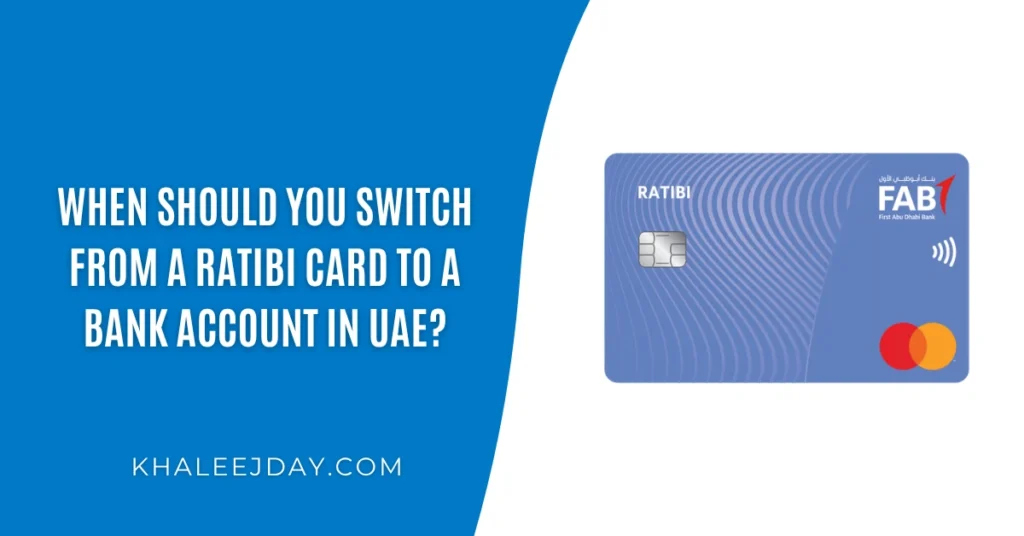
If you are working in the UAE and earning up to AED 5,000, your employer probably pays your salary through a Ratibi prepaid card. The card works well for basic needs — you can withdraw cash from ATMs, check your balance online, and receive your salary on time through the WPS system.
But at some point, you may wonder: should I open a proper bank account instead? And if yes, which bank should I choose?
This guide will help you understand when it makes sense to switch, what you gain by switching, and how to pick the right bank account for your salary level.
What the Ratibi Card Does Well
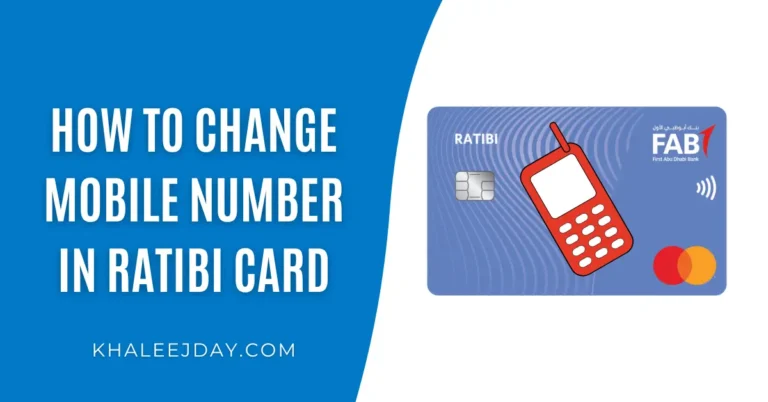
The Ratibi card from FAB is designed to be simple. Here is what it gives you:
- Your salary is deposited directly to the card
- Free ATM withdrawals at FAB ATMs across the UAE
- No monthly fees or minimum balance
- Free SMS alerts when salary is deposited
- You can use it for purchases in stores and online
- Free personal accident insurance
For many workers, this is enough. If you mainly need to withdraw cash, send money home through an exchange house, and buy groceries, the Ratibi card covers your needs.
When the Ratibi Card Is Not Enough
There are situations where a prepaid salary card starts to limit you:
You want to save money and earn interest. The Ratibi card does not pay any interest on your balance. If you keep AED 2,000-3,000 on the card between salary payments, that money earns nothing. A savings account at a UAE bank can pay 3-5% interest on your balance right now.
You want to send money home cheaper. With a Ratibi card, most people go to an exchange house to send remittances. If you have a bank account, you can use the bank’s own remittance service or apps like Wise, which often offer better exchange rates and lower fees.
You need a credit card. You cannot get a credit card with just a Ratibi card. Banks require a salary account to issue credit cards. Even a basic credit card with cashback on groceries and fuel can save you AED 50-100 per month if you use it for regular spending instead of cash.
You want to apply for a personal loan. Whether it is for an emergency, education, or family needs back home, a personal loan requires a salary account with a bank. Loan interest rates in the UAE vary between 3.5% and 7% depending on the bank, so choosing the right one matters.
Your salary increases above AED 5,000. The Ratibi card is designed for salaries up to AED 5,000. Once your salary goes above this, your employer will need to pay you through a regular bank account anyway. It is better to set up your account before this happens so you can choose the bank you want, rather than rushing into whatever your employer suggests.
How to Choose the Right Bank Account
This is where most people make a mistake. They open an account at whatever bank their employer recommends, or whichever bank has a branch near their accommodation. But banks in the UAE offer very different terms, and the wrong choice can cost you money every month.
Here is what to compare:
Minimum balance requirements. Some banks require you to maintain AED 1,000-5,000 as a minimum balance. If you go below it, they charge AED 25-75 per month as a penalty. Other banks have zero minimum balance accounts. Make sure you pick one that matches your actual spending pattern.
ATM network. If the bank has few ATMs in your area, you will end up using other bank ATMs and paying AED 2-3 per withdrawal. Check how many ATMs the bank has near your workplace and home.
Remittance fees and rates. If you send money home regularly, compare the exchange rates and transfer fees between banks. The difference between the best and worst bank for INR or PKR transfers can be 1-2% on the exchange rate — on AED 2,000, that is AED 20-40 lost every month.
Account opening requirements. Some banks require a minimum salary of AED 3,000, others AED 5,000. Some require salary transfer (your employer switches your salary to that bank), others accept a salary certificate. Know the requirements before you apply.
Included benefits. Many salary accounts come with a free debit card, free chequebook, and sometimes discounts on insurance or loan rates. Compare what each bank includes.
The easiest way to compare all these factors is to use a financial comparison platform. You can compare salary cards and bank accounts side by side, filter by minimum salary, and see which banks offer the best rates for your situation. Instead of visiting multiple bank branches and asking the same questions, you get all the information in one place.
Step by Step: How to Switch from Ratibi to a Bank Account
Step 1: Research banks and compare accounts. Look at 3-4 banks that accept your salary level. Compare minimum balance, fees, ATM network, and remittance costs.
Step 2: Gather your documents. You will need your Emirates ID, passport copy, visa copy, salary certificate from your employer, and sometimes your last 3 months of bank statements (your Ratibi card statements work for this).
Step 3: Open the account. Visit the bank branch or apply online if the bank offers digital account opening. The process usually takes 1-3 days.
Step 4: Get your new account details. Once your account is open, you will receive your IBAN number and account number.
Step 5: Ask your employer to switch salary payment. Give your employer the new bank details and ask them to transfer your salary to the new account from the next pay cycle. Your employer needs to update this in the WPS system.
Step 6: Keep your Ratibi card active for one more month. Do not cancel your Ratibi card immediately. Wait until you confirm that your first salary has landed in your new bank account.
Should Everyone Switch?
No. If you earn under AED 3,000, your options for bank accounts are limited, and the Ratibi card may still be the most practical choice. The fees and minimum balance requirements at most banks would eat into a lower salary.
But if you earn AED 3,000-5,000 and plan to stay in the UAE for more than a year, switching to a proper bank account gives you access to better saving options, cheaper remittances, and the ability to build a banking relationship that can help you later with credit cards and loans.
If your salary goes above AED 5,000, switching is not optional — it is required.
Common Questions
Can I have both a Ratibi card and a bank account? Yes. Your employer will pay into one of them, but you can keep the Ratibi card active.
Will I lose my salary if I switch mid-month? No. The switch happens from the next salary cycle. Your current month’s salary goes to wherever it was set up.
Do I need to visit a bank branch to open an account? Some banks like Mashreq and Emirates NBD offer online account opening. Others still require a branch visit.
Can I open a bank account without a salary transfer? Some banks allow this with a salary certificate, but you may get fewer benefits compared to salary transfer accounts.
The bottom line: the Ratibi card is a starting point, not a destination. Once your situation allows it, moving to a real bank account gives you more control over your money and access to products that can genuinely save you money every month.