Cable Infrastructure for AI Data Centers: Powering the Digital Backbone
We are currently witnessing a seismic shift in the world of computing. The rise of Generative AI and Large Language Models has fundamentally changed how data centers are designed, built, and powered. In the past, a data center was primarily a storage locker for information; today, it is a massive computational furnace. This evolution requires a parallel revolution in the physical layers of infrastructure. As many facility operators turn to Sustainable Solar Power Solutions to offset the astronomical energy costs of these facilities, the spotlight has shifted to the cabling that must carry that power. Cable infrastructure for AI data centers is no longer a secondary consideration—it is the literal backbone that determines whether an AI model can be trained or if the system will melt under the pressure.
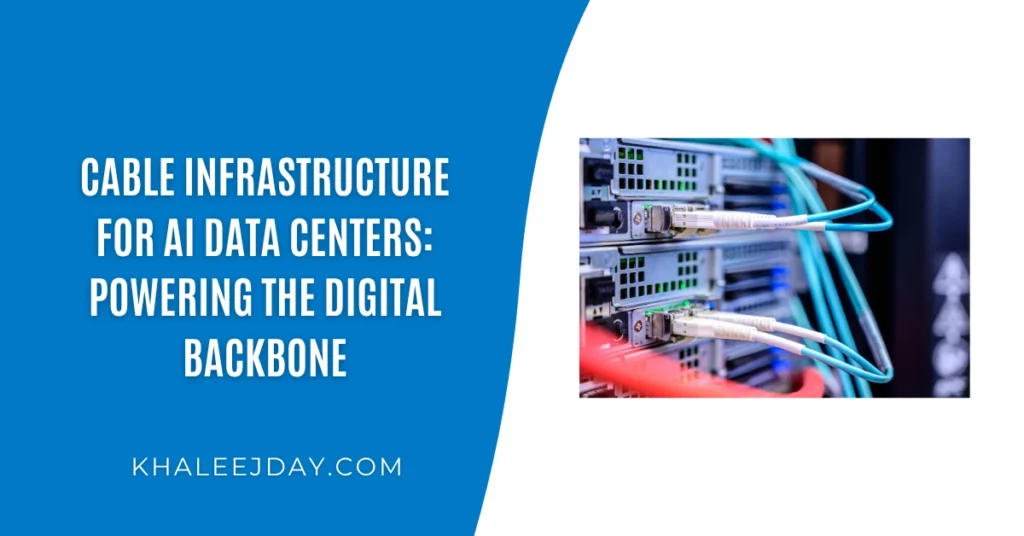
The AI Difference: Density and Demand
To understand the cabling challenge, you have to understand the hardware. Traditional data centers run on standard CPUs, which have relatively predictable power needs. AI data centers, however, run on “clusters” of thousands of GPUs (Graphics Processing Units). These chips are incredibly power-hungry. A standard server rack in a traditional data center might draw 5 to 10 kilowatts (kW). In an AI-ready facility, that same rack might draw 50, 100, or even 120 kilowatts.
This massive jump in power density creates a “thermal bottleneck.” If you try to push that much energy through standard wiring, the resistance in the copper creates so much heat that the cables themselves become a liability. Designers are now forced to rethink the entire power delivery path, from the incoming high-voltage utility lines to the tiny power cords plugging into the back of a server.
Redesigning the Power Path
When you are dealing with hundreds of megawatts of demand, efficiency is the only way to survive. Every watt lost to heat in a cable is a watt you paid for but didn’t use for computing.
1. Bringing High Voltage Closer to the Chip
In the past, voltage was stepped down at the perimeter of the data center. Today, to minimize the losses associated with low-voltage/high-current transmission, engineers are bringing Medium Voltage (MV) cables directly into the server rooms. By keeping the voltage higher for longer, they can use thinner cables and reduce the I-squared-R (resistive) energy losses.
2. High-Ampacity Busway Systems
Inside the server halls, traditional flexible cabling is being supplemented or replaced by “busways”—rigid, high-capacity copper or aluminum bars housed in protective casings. These systems can handle the massive ampacity required for AI racks far more efficiently than bundles of traditional cables. However, flexible cabling remains vital for the “final meter” connection, where flexibility is needed to navigate tight spaces.
3. Thermal Management and Material Science
Because these cables run hot continuously, standard PVC insulation is often insufficient. Engineers are specifying high-temperature rated materials that can operate at 90 or 105 degrees Celsius without the insulation becoming brittle or cracking over time. As a leading Cable Manufacturer & Supplier in the UAE, companies are developing specialized insulation compounds that prioritize heat dissipation, ensuring that the cables don’t trap heat around the already-struggling server fans.
The Fiber Optic Nervous System
While power is the “muscle” of the AI data center, fiber optics are the “nerves.” AI training involves moving trillions of parameters between thousands of chips simultaneously. This requires ultra-low latency and massive bandwidth.
- High-Density Fiber: AI facilities use ultra-high-count fiber optic cables, sometimes containing over 3,000 individual glass strands in a single jacket. These are routed through the facility to connect the “Fabric” of the AI cluster.
- Immunity to Interference: One of the biggest challenges in an AI hall is electromagnetic interference (EMI). With so much electricity flowing through the power cables, standard copper data cables would be useless due to the “noise” or crosstalk. Fiber optics, being made of glass, are completely immune to EMI, making them the only viable choice for high-speed AI networking.
The Fire Safety Mandate
In an environment where power density is at its peak and high-value hardware is everywhere, fire safety is non-negotiable. Data centers are enclosed environments with high-velocity airflow (for cooling). If a single cable jacket catches fire, the smoke and toxic gases can be whipped through the entire facility in seconds, destroying millions of dollars of hardware and endangering lives.
This is why AI facilities strictly mandate Low Smoke Zero Halogen (LSZH) cabling. In a fire, LSZH cables do not produce the dense, black, corrosive smoke that traditional PVC cables do. This protects the sensitive electronics from acid damage and ensures that visibility remains clear for emergency responders.
Conclusion: Engineering for the Intelligence Age
Artificial Intelligence feels like a digital, intangible force, but it is deeply rooted in the physical world of copper, glass, and plastic. The success of the AI revolution depends on our ability to wire it. By embracing high-density power designs, advanced thermal insulation, and massive fiber optic backbones, the cable industry is providing the stable foundation upon which the future of human intelligence is being built. As these facilities continue to scale to “gigawatt” levels, the humble cable will remain the most critical link in the chain of innovation.
Your AI Data Center Questions Answered (FAQs)
- Why do AI servers need more electricity than regular servers?
AI involves complex mathematical operations that require GPUs to run at 100% capacity for weeks or months at a time. This constant, heavy workload draws significantly more current than the intermittent tasks performed by standard servers. - Can standard data cables be used in AI facilities?
For short distances, yes, but for the main backbone, standard cables lack the bandwidth and EMI (electromagnetic interference) protection needed. High-density fiber optics are preferred to ensure data moves fast enough to keep the GPUs busy. - What is “busway” and why is it used instead of cables?
A busway is a system of rigid metal bars used to distribute high amounts of power. In AI data centers, they are used because they can carry much higher currents than traditional cables, take up less space, and dissipate heat more effectively. - How does heat affect the performance of data center cables?
Heat increases the electrical resistance of the cable. This leads to voltage drop and energy loss. If a cable gets too hot, its insulation can melt or crack, which causes a short circuit and potentially a fire. - Why is LSZH cabling so important for servers?
If a fire occurs, standard PVC cables release hydrochloric acid gas. This gas is corrosive and can permanently destroy the delicate circuits of thousands of servers, even those not touched by the fire. LSZH cables prevent this corrosive damage.