Choosing the Right Mercedes Brake Pads Replacement for Better Performance
Choosing the correct Mercedes brake pads is one of the most critical maintenance decisions you will make as an owner. From ceramic to semi-metallic, every option affects how your car stops and if you are based in the UAE, knowing when to schedule a brake pads replacement Dubai service is just as important as knowing which pad to choose.
Why Mercedes-Benz Vehicles Require Specific Brake Pads
Mercedes-Benz vehicles are not ordinary cars, and they cannot be treated as such when it comes to brake components. The Mercedes-Benz braking system is a tightly integrated network that includes ABS, Electronic Stability Program, Pre-Safe braking assist, and in many newer models, brake-by-wire technology. All of these systems are calibrated to work with precise friction compounds, specific pad dimensions, and electronic wear sensors.
Fitting generic or incompatible pads into this system can cause ABS fault codes, inconsistent pedal feel, uneven rotor wear, and significantly reduced stopping power. Beyond the electronics, Mercedes vehicles are simply heavier than most comparable cars. The GLE SUV, for instance, tips the scales at over 2,000 kg placing considerable stress on brake pads during every deceleration. Using pads designed for lighter vehicles leads to overheating, faster fade, and dramatically shorter pad life. In short, your Mercedes deserves pads engineered to match its weight, speed capability, and braking electronics.
Types of Mercedes Brake Pads: Which One Suits You?
Ceramic brake pads
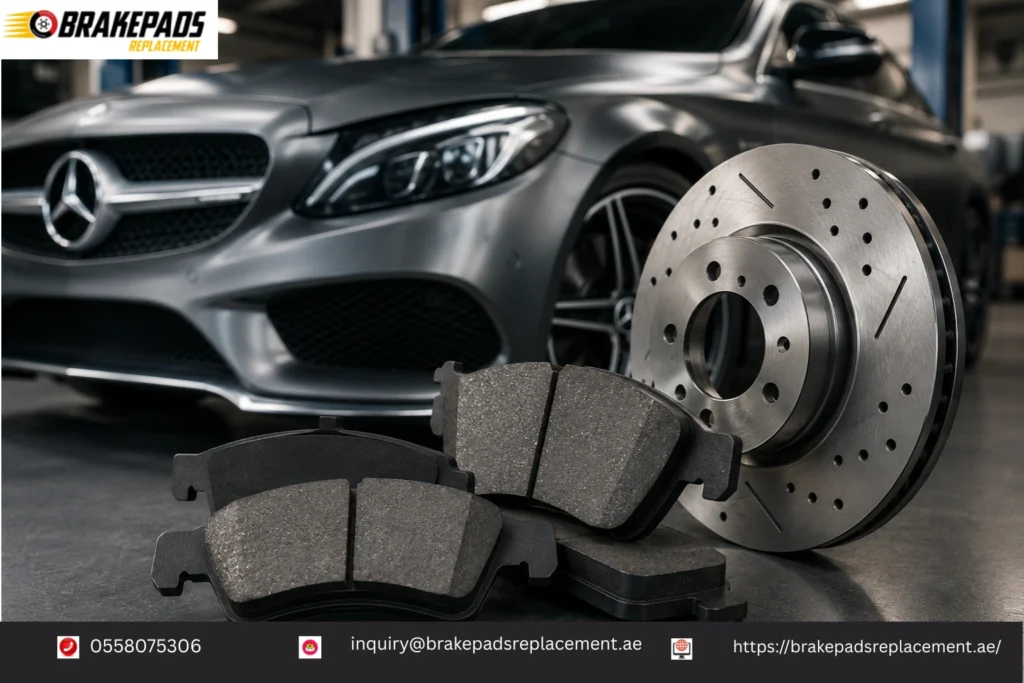
Ceramic brake pads are the most popular choice for road-going Mercedes vehicles, and for good reason. Made from dense ceramic fibres bonded with copper strands, they dissipate heat efficiently, produce minimal brake dust, and operate quietly across a wide temperature range. For owners who value clean alloy wheels, a refined driving experience, and long pad life, ceramic is the clear winner. The only real downside is cost ceramic pads are more expensive upfront. However, given their longevity, they often work out cheaper per mile over time.
Semi-metallic brake pads
Semi-metallic pads contain between 30% and 65% metal content typically a blend of steel, iron, and copper combined with other friction materials. They handle extreme heat better than ceramic pads, making them the preferred option for AMG models and drivers who frequently push their vehicles hard. The trade-off is more brake dust on your wheels, slightly increased rotor wear, and more noise at low temperatures during cold starts. For performance-oriented driving, however, the raw stopping power they deliver is difficult to match.
Organic brake pads
Organic pads are the softest and quietest option, made from materials like carbon fibre, rubber, and glass. They are gentle on rotors and produce little noise. However, they wear out considerably faster than ceramic or semi-metallic options and fade quickly under heat. For most Mercedes owners, organic pads are not the right fit. They are better suited to very light vehicles used for low-speed, low-intensity driving.
OEM vs Aftermarket Mercedes Brake Pads: What Every Owner Should Know
This is a question almost every Mercedes owner faces eventually. OEM (Original Equipment Manufacturer) brake pads are produced by the exact same suppliers that partner with Mercedes during vehicle production names like Bosch, Brembo, and ATE. OEM pads guarantee rotor compatibility, correct friction coefficient, and precise electronic sensor integration. They are the safest, most predictable choice.
Quality aftermarket pads from established brands such as Textar, Ferodo, and EBC can also perform at or above OEM standards, provided they are correctly matched to your vehicle’s model and year. The danger lies in choosing unknown budget brands with no certification or testing data. Getting this wrong is exactly why demand for proper Mercedes Brake Pads Replacement Dubai has grown consistently Mercedes owners are learning the hard way that cheap pads cost far more in the long run.
Key Factors to Consider Before Buying
- Vehicle model and year: Pad dimensions vary across the Mercedes lineup. Always confirm the exact part number for your specific model before purchasing.
- Driving style: Daily commuters benefit from ceramic pads. Aggressive or performance drivers should consider semi-metallic options with higher heat tolerance.
- Rotor condition: New pads should always be assessed alongside your rotors. Worn or grooved rotors will reduce pad performance and accelerate wear regardless of pad quality.
- Dust and noise tolerance: If clean wheels and a quiet cabin matter to you, ceramic pads are the obvious pick.
- Budget: Factor in lifespan, not just purchase price. Cheaper pads replaced more frequently often cost more overall.
Warning Signs Your Mercedes Brake Pads Need Replacing
Do not ignore these signs. Driving on worn brake pads significantly increases stopping distance and puts you and others at serious risk.
- Squealing or squeaking during braking the built-in wear indicator is contacting the rotor
- Grinding metal-on-metal noise pad material is fully worn; replace immediately
- Vibration or pulsation through the brake pedal
- Noticeably longer stopping distances than before
- Brake warning light illuminated on your dashboard
- Visible pad thickness below 3mm through the wheel spoke
As a general guideline, Mercedes brake pads last between 30,000 and 70,000 miles. Inspect them every 10,000 miles or at each scheduled service interval to stay ahead of potential issues.
DIY vs Professional Installation
Technically, brake pad replacement can be done at home by an experienced mechanic. However, many Mercedes models particularly those with electronic parking brakes, AMG Brembo callipers, or brake-by-wire systems — require specialist diagnostic tools to safely retract brake pistons and reset the system after fitting. Without these tools, the job cannot be completed correctly, and you risk leaving your braking system miscalibrated.
Professional fitting also ensures that pads are correctly bedded in a process of transferring a thin, even layer of friction material onto the rotor surface that maximises performance and minimises noise. For most Mercedes owners, professional installation is the right decision for safety, warranty preservation, and long-term reliability.
Frequently Asked Questions
Q: How often should Mercedes brake pads be replaced?
Most Mercedes brake pads last between 30,000 and 70,000 miles. Inspect them every 10,000 miles or at each service interval depending on your driving conditions.
Q: Are ceramic or semi-metallic pads better for a Mercedes?
Ceramic pads are better for everyday road driving — quieter and cleaner. Semi-metallic pads suit high-performance or heavy-duty use where heat dissipation is a priority.
Q: Can I use generic brake pads on my Mercedes?
It is strongly discouraged. Generic pads may not match the required friction coefficient or sensor compatibility of the Mercedes-Benz braking system, which can compromise safety and trigger fault codes.
Q: Do I need to replace rotors when changing brake pads?
Not always. Replace rotors if they are below minimum thickness, scored, or warped. Always verify rotor compatibility when fitting new pads to ensure even and safe braking.
Q: What does Mercedes brake pad replacement typically cost?
The cost varies depending on your model, pad type, and whether you choose OEM or quality aftermarket parts. AMG and larger models naturally cost more than standard variants.
Conclusion
Your Mercedes-Benz is a precision machine, and every component in it should meet that same standard — especially your brake pads. From understanding the difference between ceramic, semi-metallic, and organic options to making the right call between OEM and quality aftermarket alternatives, every decision you make directly affects your safety and driving experience. Do not compromise on stopping power. Choose the right Mercedes brake pads, have them fitted by certified professionals, and drive with the confidence that your vehicle was engineered to deliver.