How to Know If Your Next Project Actually Needs an Acoustic Piping System
Not every building project needs acoustic drainage. That’s a straightforward fact, and it’s worth stating clearly before anything else — because one of the more common points of confusion in the specification process is treating acoustic piping as either universally necessary or categorically optional. The reality sits somewhere more specific, and understanding where your project falls in that picture is a more useful exercise than defaulting to either position. The SereneTech system exists to solve a specific problem in specific building types — and knowing whether that problem applies to your project is the right place to start.
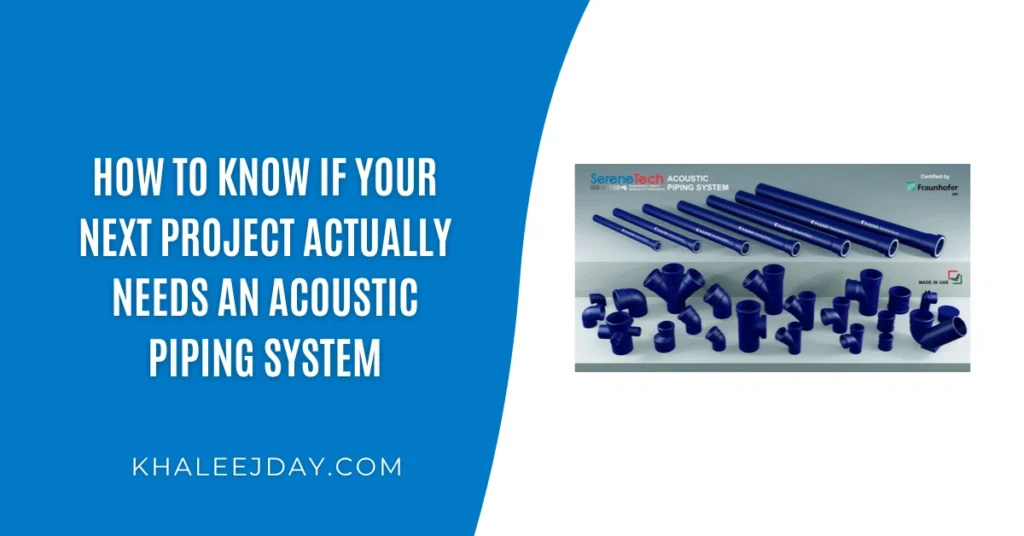
What Acoustic Drainage Actually Solves
Before getting into which projects need it, it helps to be clear about what acoustic drainage actually does. Standard uPVC drainage pipe transmits noise in two ways: airborne noise generated by water flowing inside the pipe and structure-borne vibration that travels through the pipe wall into the building fabric—the slab, the walls and the ceiling of the floor below.
In buildings where drainage routes run through mechanical spaces, service corridors, or uninhabited areas, the noise transmission simply doesn’t matter in any practical sense. A plantroom isn’t a bedroom. A riser shaft isn’t a consultation room. When no one is occupying the spaces where drainage noise travels, it remains exactly what it should be — a background function of the building that no one notices.
The problem arises when drainage routes run through or adjacent to occupied spaces where noise sensitivity matters — bedrooms, patient rooms, hotel suites, classrooms, meeting rooms, residential apartments. In those contexts, drainage noise becomes a genuine occupant-experience issue, and it’s significantly harder and more expensive to address after construction than before.
The Project Types Where Acoustic Drainage Is Non-Negotiable
Some building types make the acoustic drainage decision straightforward. If your project falls into one of these categories, the question isn’t really whether acoustic drainage is needed — it’s when in the design process to confirm it.
High-rise residential towers are the clearest case. In a multi-story residential building, drainage stacks run vertically through the building past multiple occupied floors. The noise generated by drainage activity on upper floors travels down the stack and can be clearly audible in bedrooms and living spaces on lower floors if the pipe system isn’t designed to manage that transmission. In any residential project where bedroom acoustic comfort is part of the quality proposition — which in the GCC market covers a significant proportion of new residential development — acoustic drainage is standard, not optional.
Hotels and serviced apartments occupy the same category for commercial reasons as much as technical ones. A hotel guest who can hear drainage noise through the ceiling or wall of their room has had a poor experience. In a market where online reviews have a direct and measurable impact on occupancy rates and average room rates, the cost of drainage noise complaints in a completed hotel significantly exceeds the cost of acoustic drainage specified. For any hotel project above the budget segment, this decision is already made.
Hospitals and healthcare facilities add a clinical dimension to the acoustic argument. In patient wards, consultation rooms, and clinical spaces, acoustic performance is directly connected to patient recovery, clinical concentration, and compliance with healthcare facility standards. Drainage noise in these environments isn’t just a comfort issue — it’s a clinical one.
The Projects Where It’s Worth Evaluating Carefully
Not every project falls neatly into the needs-it or doesn’t-need-it column. There’s a middle category — buildings where the acoustic drainage decision is genuinely worth sitting down to think through, rather than automatically calling in either direction.
Mixed-use developments — buildings that combine residential, retail, hospitality, or office functions within the same structure — present an interesting assessment challenge. The residential and hospitality floors clearly benefit from acoustic drainage. The retail and commercial floors may not require it to the same standard. The question for the MEP team is whether the efficiency gain from standardizing on a single system throughout the building outweighs the cost difference of using acoustic drainage only where it’s genuinely needed. In most mixed-use buildings, a floor-by-floor assessment based on the sensitivity of the occupied use on each level is the most precise approach.
Office buildings are another category worth thinking through carefully. Standard commercial offices — open-plan floor plates where ambient noise levels are already significant — rarely require acoustic drainage, because the drainage contribution to the overall noise environment is negligible against everything else happening in the space. Executive suites, boardrooms, and high-specification commercial spaces where acoustic quality is part of the building’s value proposition are a different consideration.
Educational buildings sit somewhere in the middle of this assessment. A standard classroom operates with a baseline of ambient noise that makes drainage contribution largely irrelevant. But libraries, exam halls, and quiet study spaces are different environments — with lower ambient noise, greater sensitivity, and occupants whose ability to concentrate is directly affected by acoustic disruption. A school or university project with a meaningful proportion of these spaces is worth assessing zone by zone rather than treating the whole building the same way.
The Assessment Questions Worth Asking
For project teams who are genuinely uncertain about whether acoustic drainage is warranted, a structured set of questions tends to clarify the decision quickly.
What is the sensitivity of the occupied space adjacent to or below the drainage routes? The higher the sensitivity — residential bedroom, hotel suite, patient room, examination hall — the stronger the case for acoustic drainage.
What are the expectations of the end user or building operator? A developer building for sale in a premium residential segment has a different obligation than one building for a commercial tenant. A hotel operator with a specific star rating and guest experience standard has different requirements than a budget accommodation provider.
What happens if drainage noise becomes a complaint post-handover? In some building types, the consequences of getting this wrong are manageable. In others — a five-star hotel, a luxury residential development, a private hospital — the reputational and commercial consequences of noise complaints are significant enough that the risk of getting it wrong outweighs the cost saving of not specifying acoustic drainage.
Where the Plastic Piping System Fits Into the Broader Picture
It’s also worth noting that the acoustic drainage decision doesn’t operate in isolation from the selection of piping accessories and other drainage system components for a project. In many buildings, the right answer is acoustic drainage in the areas where noise sensitivity is high and standard drainage in the areas where it isn’t. Getting that zoning right at the specification stage — rather than defaulting to one system throughout — is how cost-conscious project teams deliver acoustic performance where it matters without over-specifying in areas where it doesn’t.
The assessment isn’t complicated. It just needs to happen early enough in the design process to influence the specification before the structural coordination is locked in — which, as most MEP teams know from experience, is earlier than it usually is.