Peptides for Longevity & Anti-Aging: Understanding SS-31 and GHK-Cu Research
The pursuit of healthy aging has become one of the most active areas of modern scientific research. As researchers continue investigating the biological mechanisms associated with aging, cellular function, and longevity, peptide science has emerged as an increasingly important field of study.
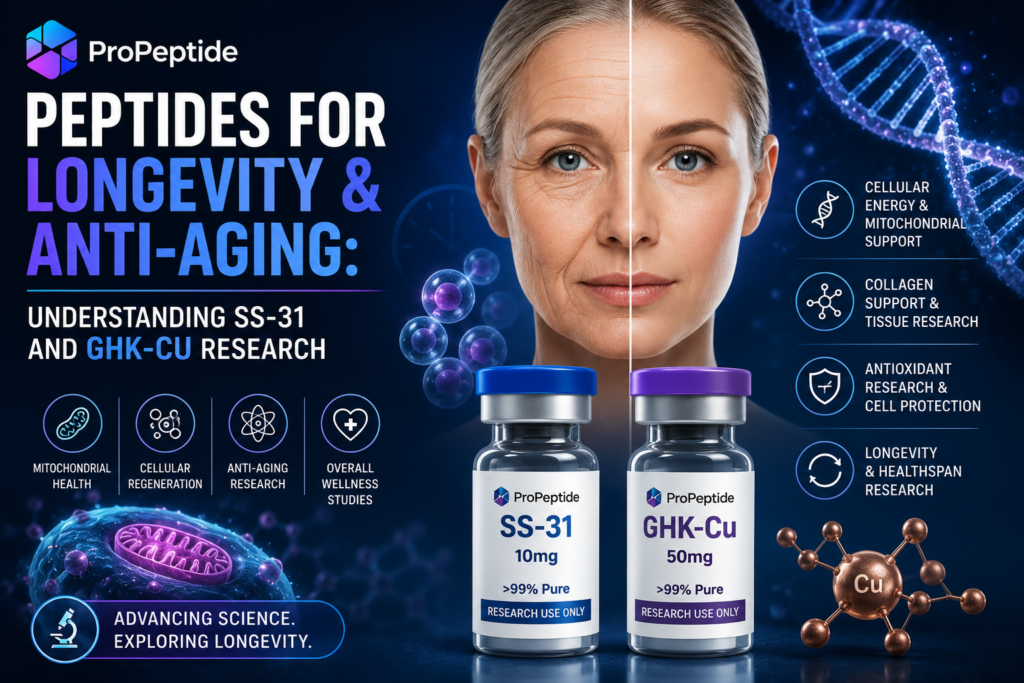
Among the compounds attracting attention in longevity research are SS-31 and GHK-Cu. Both peptides are being investigated for their potential involvement in cellular maintenance, oxidative stress regulation, and biological pathways associated with aging. While research remains ongoing, these compounds have generated significant interest among scientists, biohacking communities, and longevity-focused researchers worldwide.
It is important to note that the compounds discussed in this article are intended for laboratory and scientific research purposes only. Current studies focus on biological mechanisms and experimental investigation rather than human therapeutic applications.
Why Longevity Research Matters
Aging is a complex biological process influenced by genetics, cellular health, environmental factors, and metabolic function. Researchers continue searching for ways to better understand how cells change over time and what biological factors may contribute to healthy aging.
Several key areas of longevity research include:
- Cellular maintenance mechanisms
- Oxidative stress management
- Mitochondrial function
- Tissue regeneration pathways
- Cellular communication systems
Peptides have become valuable tools in these investigations because they can interact with specific biological signaling pathways.
Understanding GHK-Cu Research
GHK-Cu, often referred to as a copper peptide, is one of the most extensively studied peptides in regenerative and anti-aging research.
First identified in human plasma, GHK-Cu has been investigated for decades due to its relationship with various biological processes associated with tissue maintenance and cellular signaling.
Researchers have explored its potential involvement in:
- Skin biology research
- Collagen-related studies
- Cellular regeneration pathways
- Tissue remodeling mechanisms
- Oxidative stress investigations
Because GHK-Cu naturally occurs within the body, scientists remain interested in understanding how its levels and activity may influence biological aging processes.
The Growing Interest in SS-31
SS-31 is another peptide attracting attention within longevity and cellular health research.
Unlike many peptides that focus on external tissue-related pathways, SS-31 research frequently centers on mitochondrial biology. Mitochondria are often described as the power-producing structures within cells, making them an important area of investigation in aging research.
Scientists are studying SS-31 because of its potential interactions with:
- Mitochondrial function
- Cellular energy systems
- Oxidative stress pathways
- Metabolic efficiency
- Cellular resilience mechanisms
These research areas have helped position SS-31 as a significant subject within longevity science.
The Connection Between Cellular Health and Aging
Many researchers believe that healthy aging is closely linked to maintaining cellular function over time. As cells encounter environmental stressors and natural biological changes, their ability to function efficiently may gradually decline.
Current longevity research focuses on understanding factors that influence:
- Cellular communication
- Energy production
- Tissue maintenance
- Oxidative balance
- Regenerative capacity
Peptides such as SS-31 and GHK-Cu provide researchers with tools to explore these mechanisms in greater detail.
Why GHK-Cu Remains a Popular Research Topic
Among longevity-focused compounds, GHK-Cu continues to receive significant scientific attention due to its broad range of biological interactions.
Researchers investigating GHK-Cu research in healthy aging studies often examine how this peptide may interact with pathways related to cellular maintenance, tissue biology, regenerative mechanisms, and age-associated physiological processes.
Its long history in scientific literature has helped establish GHK-Cu as one of the most recognized peptides within longevity, regenerative biology, and anti-aging research.
Biohacking and Longevity Research Trends
The growing popularity of biohacking has increased public awareness of peptide science. While researchers focus on laboratory investigations, biohacking communities frequently follow developments in peptide research because of their interest in optimization and longevity-related science.
This growing interest has encouraged further investigation into:
- Cellular resilience
- Healthy aging biology
- Regenerative mechanisms
- Mitochondrial health
- Biomarker research
As a result, peptides remain a central topic within discussions about future longevity science.
The Importance of Research Quality
Reliable research depends heavily on compound quality and testing standards.
Researchers typically prioritize:
- Third-party laboratory verification
- Purity testing
- Batch consistency
- Transparent documentation
- Quality control standards
Access to properly tested research materials helps ensure accurate and reproducible scientific findings.
Future Directions in Longevity Science
Longevity research continues to evolve rapidly. Scientists are exploring increasingly sophisticated approaches to understanding aging and cellular function.
Future investigations are expected to focus on:
- Advanced peptide technologies
- Mitochondrial biology
- Cellular regeneration pathways
- Healthy aging biomarkers
- Precision longevity research
As scientific knowledge expands, peptides such as SS-31 and GHK-Cu will likely remain important subjects of investigation.
Conclusion
Peptide science is playing an increasingly important role in longevity and anti-aging research. Through ongoing investigations into compounds such as SS-31 and GHK-Cu, researchers continue to improve our understanding of cellular maintenance, mitochondrial function, and age-related biological processes.
While much remains to be learned, these studies are helping advance the broader field of longevity science and providing valuable insights into the mechanisms that influence healthy aging.
Disclaimer: This article is intended for educational and research purposes only. The compounds discussed are research materials intended for laboratory use only and are not presented as medical treatments, therapies, or products for human consumption.