Research-Use-Only Peptides: A Guide for UAE Laboratory Buyers
Research-use-only notice: the materials discussed here are for in-vitro laboratory research only. They are not for human or veterinary use, and nothing in this article is medical advice.
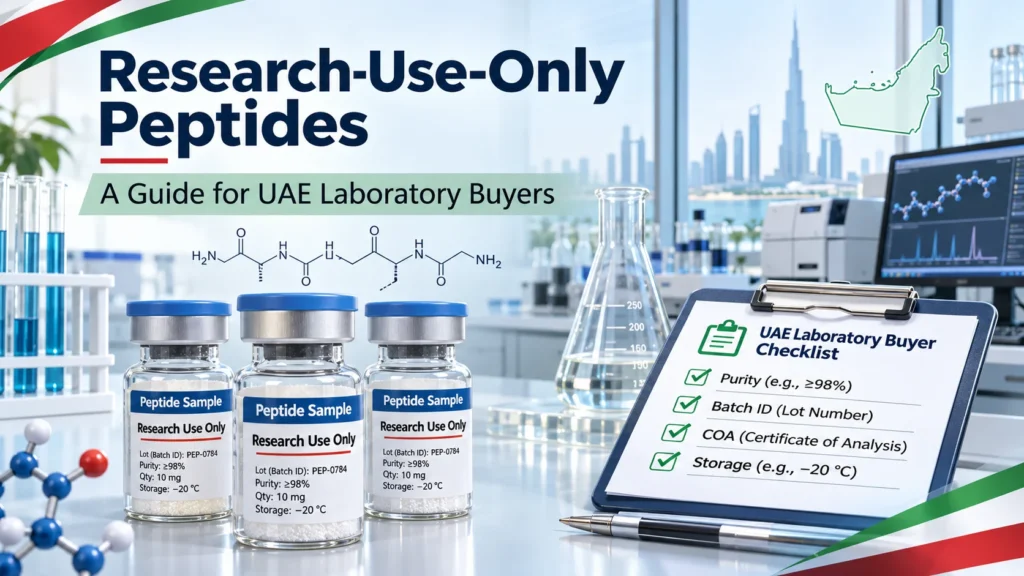
“For research use only” is among the most repeated phrases in the peptide trade, and among the least examined. It appears on labels, product pages, and invoices, and buyers tend to read it as a formality. It is better read as a statement of purpose with consequences for how you buy, record, store, and use the material.
This guide is for people who procure research peptides UAE suppliers offer on behalf of a laboratory, a university group, or a company’s R&D team. It explains what the label means, what it does not mean, and which questions are worth asking before a purchase order is signed.
What “Research Use Only” Actually Says
The label describes the intended use of the material: in-vitro laboratory research. That means experiments conducted outside a living organism, such as work with cell cultures, analytical assays, or method development.
It also states what the material is not for. Suppliers that use the label properly say, in plain words, that the products are not for human or veterinary use, and that nothing on their site is medical advice, diagnosis, treatment, or prevention.
Notice what the label does not do. It does not approve the material for any use. It does not describe quality. And it does not move responsibility away from the buyer.
The Label Is Not a Quality Statement
A peptide marked research-use-only can be excellent or poor. The label says nothing about purity, content, identity, or handling. Those answers come from documentation: laboratory reports, batch identifiers, and a clear account of what was tested.
That is why careful buyers evaluate two separate things. One is the stated purpose of the material. The other is the evidence about the material itself, found in batch documentation and certificates of analysis. A product can satisfy the first and fail the second.
The Buyer’s Responsibilities
Responsibility in this market is shared, but a large share sits with the purchaser. Reputable suppliers say so openly. The disclaimer on Remy Research’s website, for instance, states that buyers are responsible for reviewing local regulations, handling requirements, and institutional research policies.
In practice, that means a laboratory buyer should:
- Confirm that the purchase fits the institution’s own rules for sourcing and recording materials
- Check applicable local regulations, rather than assuming the supplier has done so on the buyer’s behalf
- Keep purchase, receiving, and storage records that match the stated research purpose
- Keep the material within the laboratory environment it was bought for
No supplier’s label substitutes for that diligence. If your institution has a procurement or compliance office, involve it early.
Documentation to Request Before Ordering
Treat the purchase like any laboratory procurement. Before ordering, ask for:
- The batch assigned to your order, so you know what to match against
- The laboratory report for that batch, if one exists, with its report or task number
- A way to verify the report, such as a verification key or a route to the issuing laboratory
- A statement of what was tested, including methods, and what was not
- The format that was tested, whether exact or mapped from another strength
- Storage and handling conditions the supplier recommends
The published peptide lab reports from a supplier such as Remy Research are an example of what the second and third items can look like when a seller puts them in public view. Whether a supplier offers this level of detail tells you something about how it manages its records.
Storage, Shipping, and Receiving
Peptides are sensitive materials, and handling affects what you end up with. Ask how the supplier stores stock and how orders are packed for transit. Some state their own practice, for example refrigerated storage at 2–8°C, out of light, and insulated packaging for delivery. Treat such statements as the supplier’s own description, and ask how they are documented.
When a delivery arrives, check the seal, label, and batch number against your order and the report before the material goes into storage. Record the date and condition. This small routine makes a later dispute easier to settle and a later audit easier to pass.
What Reports Can and Cannot Tell You
Laboratory reports are central to any evaluation, but they have clear limits:
- A report applies only to the identified sample or batch.
- A purity result does not establish sterility, and it does not establish safety for human use.
- A report is not a regulatory approval, and it does not on its own show compliance with UAE requirements.
- Absence of a test is absence of information, not a pass.
Suppliers worth trusting state these limits themselves.
Warning Signs
Some patterns suggest a supplier is treating the label as decoration:
- Marketing that implies use on people or animals, despite the research-use-only wording
- Dosing, administration, or “results” language anywhere on the site
- Reports with no batch number, no laboratory name, or no verification route
- Purity claims with no accompanying document
- Pressure to buy quickly and a reluctance to answer documentation questions
If you see these, slow down. A research-use-only supplier should be as comfortable with a documentation request as with a sales enquiry.
A Short Procurement Checklist
| Check | Why it matters |
| Intended use stated as in-vitro research only | Confirms the supplier’s own stated purpose |
| Batch number tied to the report | Makes the evidence traceable |
| Independent laboratory named | Shows who produced the data |
| Verification route available | Lets you confirm authenticity |
| Limits stated openly | Signals honest documentation |
| Institutional approval where required | Protects your organisation |
FAQs
What does research use only mean?
It means the material is supplied for laboratory research, such as in-vitro work, and not for human or veterinary use.
Does the label guarantee quality?
No. Quality is shown through laboratory documentation, not through the label.
Who is responsible for checking local regulations?
The buyer. Suppliers commonly state that buyers must review local regulations, handling requirements, and institutional policies.
Can a report show that a peptide is safe?
No. Purity testing does not establish sterility or safety for human use, and these materials are for in-vitro laboratory research only.
Conclusion
The research-use-only label is a starting point, not a verdict. It tells you what the supplier says the material is for. What you do next, asking for the batch record, verifying the report, checking your institution’s rules, and keeping clean receiving records, is what turns a purchase into documented laboratory practice. Buyers who work this way find that good suppliers welcome the scrutiny, and that is the clearest signal available.
These materials are supplied for in-vitro laboratory research only. Not for human or veterinary use.