The Complete Guide to Off-Grid Water Management for Extended Wilderness Stays
What makes trips end early? Not mechanical failures, not weather, water. Specifically, the absence of it. Most people attend to their water needs as if they’re on a long weekend, run a deficit by day three, and then begin either dangerously rationing or scrubbing the trip. If you want to be out there for a while, this article will walk you through how much you need, and then we will present tools to measure it, ideas to make sure you get it, discuss collecting it for treatment and safe drinking, and arranging for storage on board.
Building a Realistic Water Budget
Before you load a single litre, you need a number. The baseline most experienced overlanders use is 4 to 5 litres per person per day for a conservative, low-exertion camp. That breaks down roughly as follows: 2 litres for drinking, 1 litre for food preparation and clean-up, and 1 litre for basic hygiene like handwashing and toothbrushing. In high-heat or high-exertion conditions, that floor rises fast, the World Health Organization puts the minimum for basic hydration, food prep, and hygiene at 7.5 to 15 litres per person per day in demanding scenarios, which is a number worth keeping in the back of your mind when planning a technical traverse in summer.
For a solo 14-day trip at the conservative 5-litre baseline, you’re looking at 70 litres of personal use water. A party of two doubles that to 140 litres before you’ve accounted for a single extra wash cycle or a dusty day that demands more drinking. The critical step most people skip is separating utility water from potable water in the budget itself, not just in storage. Cooking and drinking water must be filtered and treated. Dish rinse water doesn’t need to meet the same standard. Running everything through your best filter because you didn’t plan the split costs you filter life and time.
The Physics of Carrying Water in a Vehicle
Water has high mass. So, a 100-litre tank equates to a 100 kg ballast, and where that ballast is located in your vehicle has a big effect on both its handling characteristics and your safety.
Physically, you want your water tanks as close to over the axles as you can get them, for the lowest and most central weight placement. Too much weight hanging off the rear of the truck (in a drawer or a canopy, or on a high rearward tank) multiplies the tip weight on the back of the truck. This affects steering response on hard-packed roads and technical tracks.
Secondly, you have liquid slosh, technically “free surface” in stability discussions. You get a large portion of the mass of the water moving around the tank every time you take a corner or go down a steep slope, forcing you to correct the truck back towards where you want it to be. Baffled tanks are more expensive to build, but non-negotiable off-road. Baffles are internal dividers that break the tank into smaller ones, inhibiting the water from moving more than a small distance before hitting a “wall”.
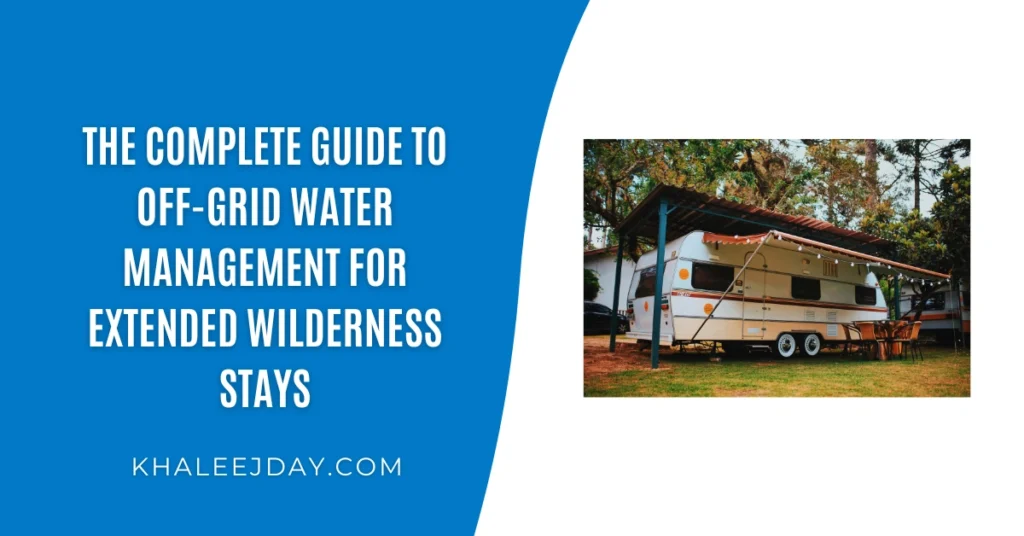
A purpose-built camper trailer addresses this with dual underslung tanks with steel bash plates and internal baffles in each tank. The three-millimetre steel bash plates are part of (not separate from) the chassis of the trailer and protect the vulnerable, low-hanging tanks against rock strike. The water tanks, one either side in front of the axle, carry your single biggest ballast, with 150 litres standard and capacity for up to 165 litres.
Multi-Stage Filtration: Why One Filter Isn’t Enough
No single filter can handle all of that. Mechanical sediment removal and biological microbe purification require separate systems. You wouldn’t put a biological bacterial filter in direct contact with the unfiltered source water; the physical sediment would rapidly clog it.
Stage one: big stuff, a 50-micron mesh that removes anything you could see, silt or organic goo. Stage two: sub-micron ultrafine filter, a 0.1 to 0.2 micron ceramic or hollow-fibre membrane. Big stuff, animals, and protozoa, particularly Cryptosporidium and Giardia, that’s the game. Giardia lamblia cysts are roughly 8 microns across. Cryptosporidium oocysts are about four microns. One cubic micron is a sphere 1/1000th of a millimeter (a micron) in diameter. Block everything bigger than 0.2 microns, and you’re golden.
Viruses range in size from 0.02 to 0.3 microns, and many field filters advertised as “viral” aren’t really reliable in the field. In practice, the viral load in natural water is low, particularly in cold, clear water high in the mountains or far from any human activity. But “usually low” isn’t a risk management strategy for a two-week stay.
So this is where chlorine dioxide tablets come in as insurance. ClO2 in particular is one of the few treatment methods that’s actually both reliable and effective against viruses in cold, turbid water. Sodium dichloroisocyanurate is a bit cheaper, with slightly inferior cold-water performance, but the better of the chemical options. Carry both and know which scenario each is suited for.
RO (reverse osmosis) systems produce the cleanest water of all, removing dissolved solids that pass right through most filters. They lose between three and five litres for every one they produce, however. Most people will want to reserve this technology for preplanted caches.
Rainwater Harvesting in the Field
A well-designed awning isn’t just about providing shade, it can also serve as a source of water collection. Nowadays, expedition awnings come with several square meters of catchment area. During heavy rainfall, this surface can help you collect tens of liters of water in a very short time.
To collect and store this water, the first-flush diversion method is the safest way to use it. The very first water to run off of any surface is dirty. It washes away dust, bird droppings, and pollen, as well as all the other things that may have collected since the last time it rained. You simply divert and discard this dirty water, then capture the cleaner water that follows it and direct that into your reservoir. This typically means the first 2 liters of runoff from an awning, but this solution is easy to implement with a basic diverter fitting or even just a manual valve that you close once the initial flush has run.
If you need to extend your catchment area further, a heavy-duty tarp pitched toward a central low point with a bucket below it will also add to your water reserves. TPU water bladders are an excellent choice for secondary storage when it comes to catchment as they pack flat when empty. They take up virtually no room while you’re traveling, or once you’ve used up what you’ve collected.
12V Plumbing and Pressure Management
A 12V water pump is what makes a trailer kitchen and washing station actually functional. The thing is, people tend to massively underestimate the flow rate relative to pressure variable. A high-pressure domestic-style tap will deliver water at a rate typically closer to 8 to 10 litres per minute. Fitting a low-flow aerator to the same tap can drop that to 2 litres per minute for basically no loss in wash velocity or spray pattern. The conservation difference over a full day of use is immense, up to 50% reduction in utility water consumption from a fitting change alone.
Pressurised plumbing loops also allow you to pre-set system pressure with an accumulator tank, which smooths pump cycling and extends pump motor life. A pump that’s constantly switching on and off under demand wears faster than one that pressurises a small accumulator and only runs when that reserve drops below threshold.
Redundant Systems and Bypasses
Electricity goes away. A blown fuse, a corroded connector, a pump impeller that takes a rock hit, any of these takes down your 12V water system in a heartbeat. The right answer is to design around the failure before it happens.
The solution is to add inline bypass valves. A simple T fitting with a manual ball valve allows you to isolate your 12V pump from the plumbing circuit and instead route flow through a manual outlet. Combined with a foot pump or hand siphon you can still draw directly from your primary storage tanks with no electrical system involved. The bypass weighs almost nothing and adds $10 and it means a pump failure is an inconvenience rather than a system loss.
Sometimes you also want a siphon pump to transfer from a flexible bladder or a pair of jerry cans into your main tank without power. Jerry cans, specifically, the military-grade ones like the Scepter, are kept around as emergency reserve vessels for exactly this reason as they are completely independent of the plumbing system. Two 20-liter jerry cans strapped to a rear carrier is forty liters of reserve that’s accessible no matter what’s happening with your onboard.
Greywater Disposal and Tank Sanitation
Washing utensils, hands, and gear can generate a surprisingly high volume of greywater, water that shouldn’t be simply dumped at camp. Even the natural residues of biodegradable soaps can alter soil and water chemistry and, in riparian zones, prove harmful. The standard field treatment is to scatter by broadcasting widely across broad ground at least 60 metres from any lake, river, or stream. Natural soil processes can then break down the residue before it reaches a water source.
Inside the tanks themselves, sanitation during long trips is a real issue; biofilm builds up in storage tanks over days and weeks. The standard treatment ratio for food-grade sodium hypochlorite (household bleach) is approximately one quarter a cup to 15 gallons, or about 60 mL to 57 litres of tank capacity. Fill the tank, add the bleach solution, let sit for several hours with the tank agitated if possible, then flush the system through before use. Silver-ion-based preservatives are an alternative that works at much lower concentrations, and leave none of the taste residues of chlorine, but they cost more.
Putting the System Together
A fully independent water system is not one thing but the proportions between the size of storage, numbers of filter, quantity of catchment, control of pressure, and level of discipline in disposal. Cascade your filtering so the cheap pre-filters are doing the heavy lifting to protect the very expensive membranes. Have the bypasses in the system before they happen naturally. Harvest the rain when it falls. Dispose of your greywater responsibly. And, for God’s sake, sanitize your tanks on time.
Get these things right and the water you are carrying doesn’t cause the vehicle to perform badly. Get it right and you don’t even notice the water on a two-week trip, because it’s not something you’re thinking about.