The Difference Between a Paint Finish That Looks Good on Day One and One That Still Looks Good in Year Five
There is a version of a freshly painted room that looks exactly right — the color is perfect, the finish is smooth, and the light hits it the way it was supposed to. And there is a version of that same room three years later, where something has gone wrong. The color has shifted. The finish has lost its quality. A section near a window has started to bubble. A corner has cracked. The room still functions. It just doesn’t look the way it did when the paint was new, and the gap between the two states is wide enough to be noticeable.
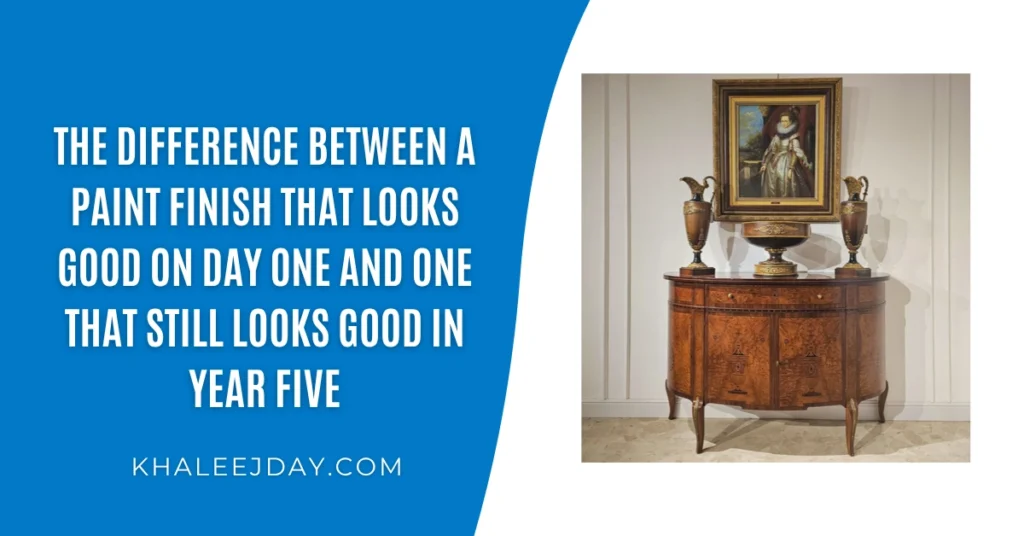
In Dubai — where the climate is demanding, the sun is intense, and the expectations for interior quality in premium residential and hospitality spaces are high — that gap appears faster and more visibly than in most comparable markets. Understanding what separates decorative paint in Dubai that holds its quality over time from paint that doesn’t starts with understanding why finishes fail.
Why Paint Finishes Fail in Dubai Faster Than Elsewhere
Dubai’s climate imposes specific, sustained demands on interior and exterior surfaces that most paint specifications don’t fully account for. The combination of intense UV radiation, high ambient temperatures, significant humidity levels — particularly during the summer months — and the temperature differential between heavily air-conditioned interiors and the exterior environment creates conditions that accelerate the deterioration of paint finishes at a pace that wouldn’t occur in more temperate climates.
UV exposure is the most significant factor for exterior surfaces and any interior surface with direct sun exposure. Ultraviolet radiation breaks down the binders in paint formulations over time, causing color to fade, surfaces to chalk, and finishes to lose the clarity and depth they had when freshly applied. In Dubai’s summer, UV intensity is high enough to compress this process considerably — what might take a decade in Northern Europe can occur in a fraction of that time under sustained Gulf sun.
Thermal movement is another underappreciated factor. Surfaces expand and contract with temperature changes, and in Dubai — where the differential between an air-conditioned interior and the exterior environment can be extreme, and where surfaces heat significantly during daylight hours — this movement is more pronounced than in moderate climates. Paint films that aren’t formulated to accommodate this movement develop stress fractures over time, which appear initially as hairline cracks and eventually as more significant surface failure.
Humidity and moisture infiltration complete the picture for surfaces in bathrooms, kitchens, pool areas, and any exterior or semi-exterior space. A decorative finish applied over a substrate that allows moisture infiltration will fail regardless of the paint’s quality — moisture finds its way to the interface between the paint film and the substrate, and the adhesion that holds the finish in place breaks down from beneath.
Surface Preparation — The Step That Determines Everything
The most consistent reason that paint finishes fail prematurely — in Dubai and everywhere else — is inadequate surface preparation. This is not a controversial claim. It is the finding that surfaces most reliably from any serious investigation of paint failure, and it is the factor most consistently underweighted in the decisions made by property owners, contractors, and applicators who are focused on the visible outcome rather than the process that produces it.
A decorative paint finish is only as durable as the surface it’s applied to. A substrate that is contaminated, poorly primed, insufficiently cured, or not properly sealed will transmit its problems through any finish applied on top of it — regardless of how premium that finish is. The best decorative paint in the world, applied over a poorly prepared substrate, will fail. A more modest finish, applied over a properly prepared surface, will significantly outperform it.
In practical terms, adequate surface preparation for a decorative paint application in Dubai means assessing the existing substrate for moisture content, adhesion, contamination, and structural integrity before any product is applied. It means selecting a primer appropriate for the substrate type and the finish being applied. It means allowing adequate cure time at each stage rather than compressing the program to meet a deadline. And it means addressing any structural issues — cracks, voids, delamination — before they become the substrate onto which a decorative finish is applied.
For surfaces with moisture exposure — bathrooms, external walls, pool surrounds, basement areas — surface preparation also means the correct waterproofing system is applied and fully cured before any decorative finish begins. The relationship between waterproofing and decorative finish is sequential and non-negotiable: waterproofing must be correct before decoration begins, because decoration applied over an inadequate waterproofing system will fail at the rate of the waterproofing, not at the rate of the decorative product.
The Waterproofing Layer That Most Projects Get Wrong
Waterproofing is the stage of a paint and finishes program that is most commonly treated as a commodity — specified at the lowest cost that meets the minimum requirement, installed by whoever is available, and signed off without the testing that would establish whether it’s actually performing. This approach sometimes works in benign environments. In Dubai, it produces predictable and expensive failures.
The waterproofing paints and systems that perform over time in the Gulf climate share a set of characteristics. They are applied to the correct thickness — waterproofing systems that are under-applied are consistently the source of failures that appear to be decorative finish failures, but are actually waterproofing failures. They are applied with the correct number of coats, with adequate cure time between coats. They are tested for integrity before the decorative work begins. And they are selected based on compatibility with the decorative system being applied on top — a waterproofing product that is chemically incompatible with the decorative finish applied over it will compromise the adhesion of that finish, regardless of how well each individual product performs in isolation.
For villa owners, hotel operators, and restaurant developers in Dubai and across the GCC, the waterproofing specification deserves more attention than it typically receives. The cost of a waterproofing failure — in remediation, disruption and damage to finishes that need to be stripped and reapplied — consistently exceeds the cost of the correct waterproofing system by a significant multiple.
What a Five-Year Finish Actually Requires
A decorative paint finish that looks as good in year five as it did on day one is not the result of selecting a premium product and hoping for the best. It is the result of a sequence of decisions — surface preparation, waterproofing, primer selection, product specification, application method, and cure management — each of which needs to be correct for the outcome to hold.
For specifiers, architects, and consultants working on premium residential and hospitality projects in Dubai and Qatar, this means treating the paint and finishes specification with the same rigor applied to other technical elements of the build. The decorative outcome is the most visible thing in any completed interior or exterior. It is also the thing most directly affected by decisions made at earlier stages that are no longer visible once the project is complete.
The property owner who walks through a newly completed villa and sees perfectly finished walls is looking at the last stage of a process. What they cannot see — the substrate preparation, the waterproofing system, the primer coats — is what determines whether what they’re looking at will still look right in five years. Getting those invisible stages correct is what separates a finish that lasts from one that doesn’t.